Deconstructing Finance
Promesses, pratiques et alternatives : un cycle de cinq ateliers pour comprendre le secteur financier.
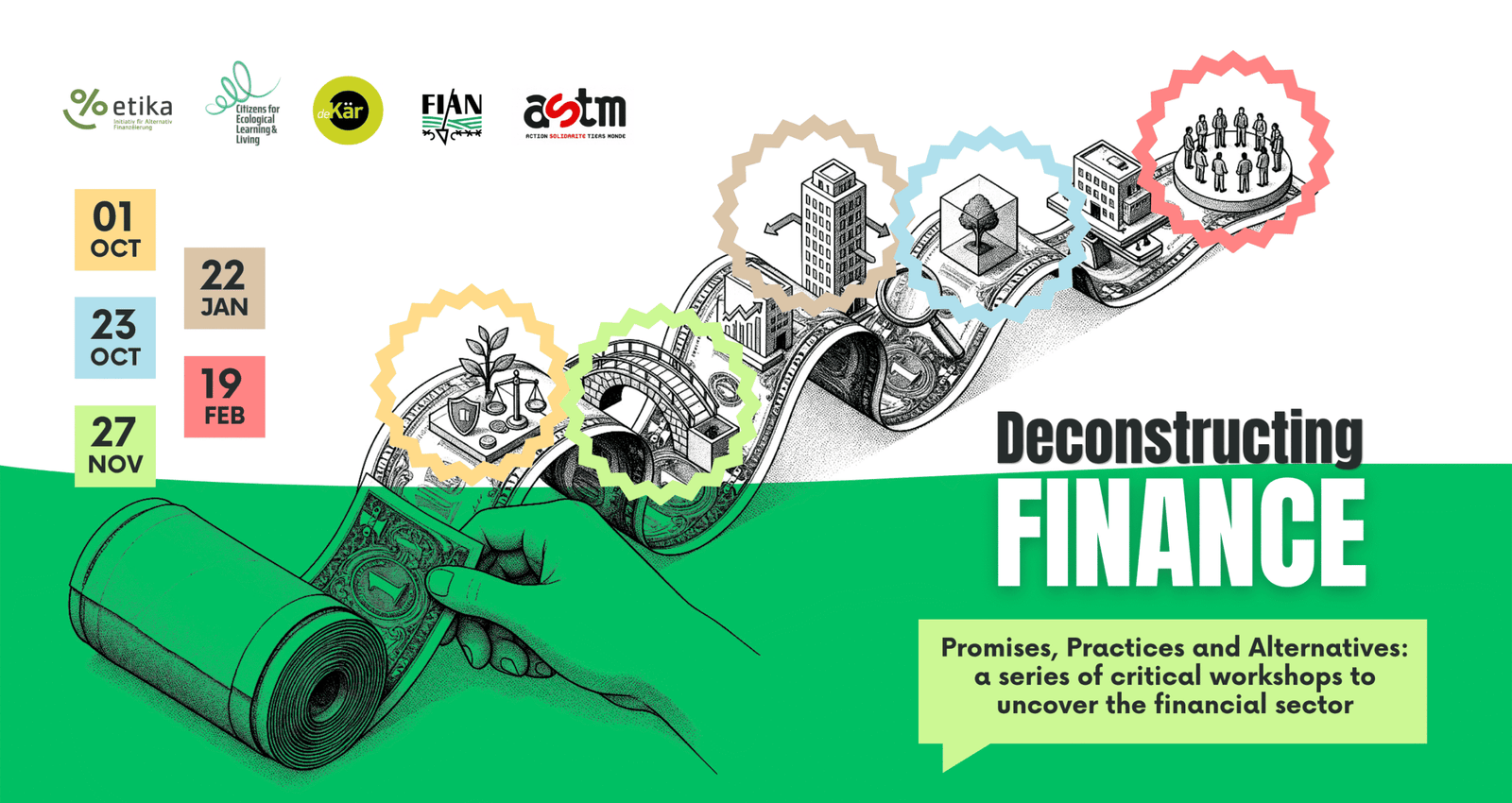
Promises, practices and alternatives: a series of five workshops to understand the financial sector.
Contexte et objectifs
About the series
Le secteur financier est le principal pilier économique du Luxembourg et joue un rôle central bien au-delà des frontières du Grand-Duché. Deuxième place mondiale pour les fonds d’investissement, acteur majeur du private equity et centre reconnu de la microfinance internationale, le Luxembourg occupe une position stratégique dans l’architecture financière mondiale.
Cette importance contraste toutefois avec une compréhension souvent fragmentée des mécanismes financiers au sein de la société civile. Pour de nombreuses organisations non gouvernementales, cette complexité rend difficile l’analyse des effets réels du secteur financier sur l’économie, l’environnement et la cohésion sociale, ainsi que l’élaboration de positions de plaidoyer solidement fondées.
Dans ce contexte, etika, FIAN Deutschland, CELL, ASTM et De Kär proposent conjointement un cycle d’ateliers thématiques visant à renforcer la capacité d’analyse critique des participant·e·s. L’objectif n’est pas de transmettre des positions prédéfinies, mais de fournir des outils de compréhension, d’encourager un examen critique des discours dominants et de favoriser un échange informé autour des pratiques financières contemporaines.
Le cycle aborde cinq thématiques clés du secteur financier, en combinant apports analytiques, discussion collective et mise en contexte luxembourgeoise. Il s’adresse à celles et ceux qui souhaitent approfondir leur compréhension du fonctionnement du système financier et des enjeux qu’il soulève, afin de pouvoir en évaluer plus librement les promesses, les limites et les impacts.
The financial sector is Luxembourg’s principal economic pillar and plays a central role well beyond the borders of the Grand Duchy. As the world’s second-largest domicile for investment funds, a major player in private equity, and a recognised hub for international microfinance, Luxembourg holds a strategic position in the global financial architecture.
This importance nonetheless contrasts with an often fragmented understanding of financial mechanisms within civil society. For many non-governmental organisations, this complexity makes it difficult to analyse the real effects of the financial sector on the economy, the environment, and social cohesion, and to develop well-founded advocacy positions.
Against this backdrop, etika, FIAN Deutschland, CELL, ASTM and De Kär are jointly offering a series of thematic workshops aimed at strengthening participants’ capacity for critical analysis. The goal is not to convey predefined positions, but to provide tools for understanding, to encourage a critical examination of dominant narratives, and to foster an informed exchange around contemporary financial practices.
The series addresses five key themes of the financial sector, combining analytical input, collective discussion, and a Luxembourg-specific perspective. It is aimed at those who wish to deepen their understanding of how the financial system works and of the issues it raises, so that they can more freely assess its promises, limits, and impacts.
Public visé
Who should attend
Ces ateliers sont ouverts à toute personne souhaitant approfondir sa compréhension du secteur financier et de ses enjeux, notamment :
- Collaborateur·rice·s d’ONG et d’organisations de la société civile
- Professionnel·le·s du secteur financier
- Représentant·e·s syndicaux et acteur·rice·s du dialogue social
- Étudiant·e·s en économie, sciences politiques, droit ou disciplines apparentées
- Journalistes et professionnel·le·s des médias
- Citoyen·ne·s engagé·e·s
Aucune connaissance préalable en finance n’est requise.
These workshops are open to anyone wishing to deepen their understanding of the financial sector and the issues it raises, in particular:
- Staff of NGOs and civil society organisations
- Professionals working in the financial sector
- Trade union representatives and actors in social dialogue
- Students of economics, political science, law, or related disciplines
- Journalists and media professionals
- Engaged citizens
No prior knowledge of finance is required.
Informations pratiques
Practical information
Le cycle
- Dates
- Octobre 2026 – février 2027 voir le détail des ateliers ci-dessous
- Horaire
- 9h30 – 12h00
- Langues
- Français (ateliers 1 et 5)
Anglais (ateliers 2, 3 et 4) - Participation
- Gratuite, inscription requise
- Inscription
- contact@etika.lu
Lieux
28, rue Münster
L-2160 Luxembourg (Grund)
L-1931 Luxembourg
The series
- Dates
- October 2026 – February 2027 see the workshop details below
- Time
- 9:30 a.m. – 12:00 p.m.
- Languages
- French (workshops 1 and 5)
English (workshops 2, 3 and 4) - Participation
- Free of charge, registration required
- Registration
- contact@etika.lu
Venues
28, rue Münster
L-2160 Luxembourg (Grund)
L-1931 Luxembourg
Les cinq ateliers / The five workshops
Chaque atelier se déroule et est décrit dans sa langue d’animation. /
Each workshop is held and described in its working language.
Finance durable : promesses, pratiques et limites
Lieu : neimënster – Centre Culturel de Rencontre Abbaye de Neumünster, salle Lou Koster (2e étage), 28, rue Münster, L-2160 Luxembourg (Grund)
Avec plus de 30 000 milliards de dollars d’actifs gérés selon des critères dits durables, la finance durable s’est imposée comme un élément significatif des marchés financiers contemporains. Elle suscite de fortes attentes, notamment de la part des épargnant·e·s souhaitant contribuer positivement à la transition écologique et sociale. Cet atelier propose d’examiner dans quelle mesure la finance durable est réellement en mesure de favoriser cette transition, en s’intéressant à l’écart entre les promesses et les réalisations observables.
À travers différentes thématiques, l’atelier reviendra sur les principaux développements de la finance durable et sur la manière dont ils influencent – ou non – les choix des entreprises et l’allocation du capital. Il abordera les attentes des épargnant·e·s en matière d’impact, les limites structurelles des instruments existants ainsi que les stratégies d’engagement actionnarial et les contraintes qui les entourent. Plus largement, l’atelier invitera à une réflexion sur les limites du secteur financier comme moteur de la transition vers une économie durable, au regard des logiques qui le structurent, notamment la gestion du risque, la recherche de rendement et la responsabilité fiduciaire.
L’objectif de l’atelier est de permettre aux participant·e·s de mieux comprendre les logiques actuelles de la finance durable et de disposer d’éléments d’analyse leur permettant d’évaluer de manière éclairée les discours, les pratiques et les produits proposés par le secteur. L’atelier s’adresse à toute personne – épargnant·e·s, investisseurs, professionnel·le·s du secteur financier, acteur·rice·s de la société civile ou simples citoyen·ne·s curieux·ses – souhaitant mieux comprendre les enjeux de la finance durable, sans qu’aucune connaissance financière préalable ne soit requise.
Animation
Julien Lefournier – ancien professionnel des marchés financiers, est un expert indépendant qui s’est spécialisé dans l’analyse de la finance durable. Ses travaux portent sur la capacité de cette finance à produire un impact réel sur l’économie et visent à contribuer à une compréhension critique des pratiques du secteur. Il est coauteur de L’illusion de la finance verte (Éditions de l’Atelier, 2021), un essai consacré à l’analyse des promesses et des limites de la finance durable qu’il vient d’adapter en bande dessinée (Finance insoutenable, Éditions de l’Atelier, 2026).
Commercial Microfinance: Over-Indebtedness Risks, Client
Protection, and Approaches to Responsible Lending
Venue: Maison des ONGD, 55, avenue de la Liberté, L-1931 Luxembourg
Microfinance loans are regarded as an important instrument for promoting financial inclusion and supporting economic activity in low-income regions. Recurring over-indebtedness crises – currently in India and Cambodia, for example, and in the past in Nicaragua, Bolivia, Pakistan, and Bosnia and Herzegovina, among others – nonetheless raise questions about the risks of commercial microfinance models. Not least, an article published in the Wall Street Journal in June 2026 has reignited the debate about the role of microfinance loans and the responsibility of the actors involved.
What factors contribute to the emergence of such crises? And how can microfinance institutions, investment managers, investors, and civil society effectively help to prevent over-indebtedness risks?
This workshop offers space for exchange and discussion on these questions. The aim is to develop a deeper understanding of the risks of commercial microlending and to discuss approaches for addressing these risks effectively.
The workshop focuses on topics including:
- Over-indebtedness risks: the vulnerable circumstances of target groups and cost pressures in global value chains
- The anatomy of past and present crises: lessons from over-indebtedness crises in India and other countries
- What works? Preconditions for responsible microcredit offerings: insights from research
- Challenges of existing approaches to preventing over-indebtedness: the practices of international development banks and client protection standards
- Requirements for responsible microlending and investment practice: approaches based on international standards (OECD)
The workshop is aimed at development cooperation professionals, actors from the microfinance sector, civil society representatives, and anyone wishing to deepen their understanding of this instrument and the associated standards, risks, and frameworks.
Facilitation
Sophia Cramer – is a sociologist specialising in (micro)finance and human rights. Her work focuses on research, policy advocacy, and education. For her PhD thesis at the University of Lucerne on the effects of accounting on microfinance institutions, she conducted several years of ethnographic field research in Latin America.
Development Cooperation in Transition: Between Aid and
Financial Markets
Venue: Maison des ONGD, 55, avenue de la Liberté, L-1931 Luxembourg
Development cooperation has changed fundamentally over the past decade. Whereas it once relied primarily on non-repayable grants, a growing share of public funding now flows into development funds, blended finance structures, and other financial vehicles. The aim is for this money not only to promote economic development in recipient countries but also to generate financial returns for investors. On the one hand, public resources are expected to be used more efficiently because, unlike traditional grants, the funding flows back at least partially – or may even generate income. On the other hand, projects expected to generate financial returns are intended to attract private capital and expand development financing well beyond the initial public investment.
The workshop examines the consequences of this financialization of development cooperation. How do these new financial structures work? What role do investment funds, development banks, and financial centres play? How much of the funding provided actually reaches people and projects on the ground, and how much remains within the financial sector in the form of management fees, service costs, and investor returns?
Particular attention is paid to Luxembourg. As the world’s second-largest fund domicile and an internationally significant hub for microfinance, the Grand Duchy plays a key role in the global architecture of development finance. A substantial share of European development banks’ investments in such funds – including those of Germany’s KfW Development Bank – is channelled through Luxembourg-based structures. What does this mean for recipient countries, for development cooperation, and for Luxembourg’s financial centre?
Using concrete case studies – such as the Luxembourg-domiciled Arbaro Fund – the workshop analyses typical financial constructions and discusses their implications for development policy. It also examines the assumptions behind the growing involvement of private financial actors and asks whether the promise that return-driven financing makes development cooperation more effective stands up to scrutiny.
The workshop is aimed at development cooperation professionals, civil society actors, journalists, and anyone interested in better understanding the relationship between financial centres and development policy.
Facilitation
Roman Herre – FIAN Deutschland
Discussant: David Hoffmann (ASTM)
The Business of Paying Less: Multinationals and Tax
Avoidance
Venue: Maison des ONGD, 55, avenue de la Liberté, L-1931 Luxembourg
Large corporations do not always pay tax where they actually do business. How they are taxed rests on a web of national and international rules that shape where profits appear on paper and where economic activity is genuinely taxed. A handful of countries, Luxembourg among them, sit at the heart of these arrangements by hosting structures such as holding companies and specialised financial entities.
This workshop examines how holding structures work, what they are used for, and the debates they raise around taxation and public finances. The aim is to make sense of the economic and legal logic behind them, and to understand what they mean for states and societies — for the public budgets that depend on tax revenue, and for the competition between countries to attract it.
Topics covered will include the fundamentals of how multinationals are taxed and the role that holding companies play within international groups, including how they function in practice. The workshop explores where tax optimisation ends and avoidance or fraud begins, and traces at least one case study following the use of Luxembourg structures within a multinational group. Participants will be introduced to hands-on research techniques for investigating such structures, which they can apply in their own work. Finally, the workshop turns to current debates and policy developments at the international level, including the role of the Global South and multilateral organisations in the international tax debate.
The workshop is aimed at those wishing to deepen their understanding of the mechanisms of international taxation, existing practices, and the associated issues in terms of public revenue, tax competition, and international policy initiatives.
Facilitation
Maarten Hietland – is an independent researcher and investigative journalist specialising in corporate finance and tax policy. With almost 10 years of experience in the field, he has worked with organisations such as Oxfam Novib, SOMO, Greenpeace and World Animal Protection. His recent work focuses on the (tax) practices of multinationals in various sectors, such as Agriculture, Mining, Oil & Gas, Big Pharma/healthcare and the surveillance industry. His most recent investigations focus on JBS, Palantir and Starbucks.
Henrique Alencar – is a Policy Advisor on Tax and Inequality at Oxfam Novib, with a primary focus on capacity development of CSOs across the Global South, campaigns on fiscal justice and drafting reports with a fiscal justice perspective. Henrique also focuses on the debt crisis, energy transition and critical minerals. He has previous professional experiences at the OECD, Wolters Kluwer, a big four consultancy firm and multinational corporations. Henrique is a law graduate in his native Brazil with two masters in International and European taxation from Tilburg University and King’s College London, with extensive experience in academic lectures and conferences.
Finance traditionnelle et finance collaborative : les
limites du système monétaire et les leviers de la finance collaborative
Lieu : Maison des ONGD, 55, avenue de la Liberté, L-1931 Luxembourg
De tout temps et plus particulièrement lorsque le système financier montre ses limites comme lors de la crise financière de 2008, de nombreuses alternatives au système financier voient le jour. Cet atelier, qui clôturera le cycle, servira à mieux comprendre les récentes alternatives et vise à ouvrir de nouvelles perspectives. Il s’attache à répondre à la question centrale suivante : comment développer des alternatives financières et monétaires compatibles avec un développement sociétal et environnemental durable ? L’atelier comporte des éléments théoriques, mais explore surtout cette question à travers des exemples concrets. Il a pour but de présenter les solutions existantes mais aussi potentielles au Luxembourg. Une mise en perspective des enjeux plus systémiques, dans le prolongement des précédents ateliers, permettra de garder le lien du local au global.
Comment des alternatives basées sur le système monétaire existant peuvent potentiellement assurer la durabilité ? Faut-il changer la monnaie elle-même ? Le workshop commence par une brève analyse critique du système monétaire actuel. Ensuite les alternatives d’investissement basées sur celui-ci sont présentées. Par la suite, différents modèles de monnaies alternatives seront analysés et mis en relation avec des sujets des ateliers précédents, notamment la finance durable et la microfinance.
Les thématiques abordées incluront notamment :
- Les mythes populaires autour de la monnaie.
- Investissements alternatifs : etika, eticrowd, coopératives énergétiques, Gringgo (« Regionalwert AG »).
- Le mouvement de la diversité monétaire et des exemples de systèmes de coopération et d’échange régionaux et résilients : monnaies locales et l’exemple du Beki ; systèmes de crédit mutuel ; IOU’s (I owe you), systèmes de clearing et l’exemple du concept de Sikoba.
- Mise en perspective : de nouveaux modèles pour la finance durable et la microfinance ?
Animation
Nicolas Franka – est économiste doctorant à l’ULiège et travaille au déploiement de systèmes de paiement complémentaires depuis plus de dix ans. Fondateur et directeur du Mouvement pour la Diversité Monétaire, qui rassemble plus de 70 organisations à travers le monde qui travaillent sur la question des monnaies. Par corollaire, ses travaux portent également sur la démocratie et les formes d’organisations collectives et communautaires.
Intervenants : Julian Bernstein (etika) · Léonard Andersen (coopératives énergétiques) · Max Hilbert (Beki, Gringgo) · Aleksander Kampa (Sikoba)
Participation gratuite – inscription requise
Indiquez dans votre message les ateliers auxquels vous souhaitez participer.
S’inscrire par e-mailLe bouton n’ouvre pas votre messagerie ? Notre adresse : contact@etika.lu
Free of charge – registration required
Please indicate in your message which workshops you would like to attend.
Register by e-mailButton not opening your mail app? Our address: contact@etika.lu